

Let’s be honest: we’ve all been there. You have a document that needs to be in another language yesterday. You look at the blinking cursor of a generic online translator, then at the quote from a professional agency, and you think, “Can’t I just let the AI handle this one?”
In 2026, AI translation isn’t just a “cool gadget” anymore, it’s a powerhouse. It’s fast, it’s getting smarter by the second, and it can handle millions of words while you’re still on your first cup of coffee. But the million-dollar question remains: Is AI translation effective for every project?
Short answer? No. Long answer? It depends on whether you’re translating a lunch menu or a high-stakes legal contract that could land you in hot water.
Let’s dive into the world of AI translation and find out when to let the machines take the wheel and when to keep a human firmly in the driver’s seat.
The “Green Light”: When AI Is Your Best Friend
AI is like a super-powered engine. When you have a straight road and a massive load, it’s unbeatable. Here is where AI translation truly shines:
- High-Volume, Low-Risk Content
If you have 10,000 pages of internal technical manuals or knowledge base articles, human translation might take months and cost a fortune. AI can churn through this in hours, providing “good enough” accuracy for people to understand the gist of the information.
- Tight Deadlines and Real-Time Needs
Hosting a global webinar with 20,000 participants? You can’t hire 50 booth-bound interpreters for every possible dialect. AI-powered machine interpretation and live captioning allow audiences to follow along on their own devices in real-time. It’s about accessibility and inclusivity on a scale humans simply can’t match alone.
- Consistency in Technical Jargon
AI doesn’t get tired. It won’t forget that on page 50, you called a “widget” a “widget,” only to call it a “gadget” on page 500. By using trained datasets and translation memories, AI ensures your technical terminology remains rock-solid across every market.
The “Yellow Light”: Proceed with Caution (Human-in-the-Loop)
Sometimes AI gets you 80% of the way there, but that last 20% is where the “magic” (and the safety) happens. This is called PEMT (Post-Editing Machine Translation).
Think of industries like:
- Healthcare: A “minor” AI mistranslation in a medical dosage instruction isn’t just an error, it’s a life-threatening risk.
- Legal: One misplaced “shall” or “may” can change the entire meaning of a contract.
- Marketing: AI is great at words, but it’s terrible at “vibes.” It might translate your catchy slogan literally, making it sound robotic or, worse, offensive in the target culture.
In these cases, we use AI to do the heavy lifting, but a native-speaking expert must review and refine the output to ensure it’s accurate, compliant, and culturally appropriate.
The “Red Light”: Why You Still Need a Human Soul
There are some things AI just can’t “feel.” If your project involves any of the following, stick with professional human linguists:
- Creative Content and “Transcreation”
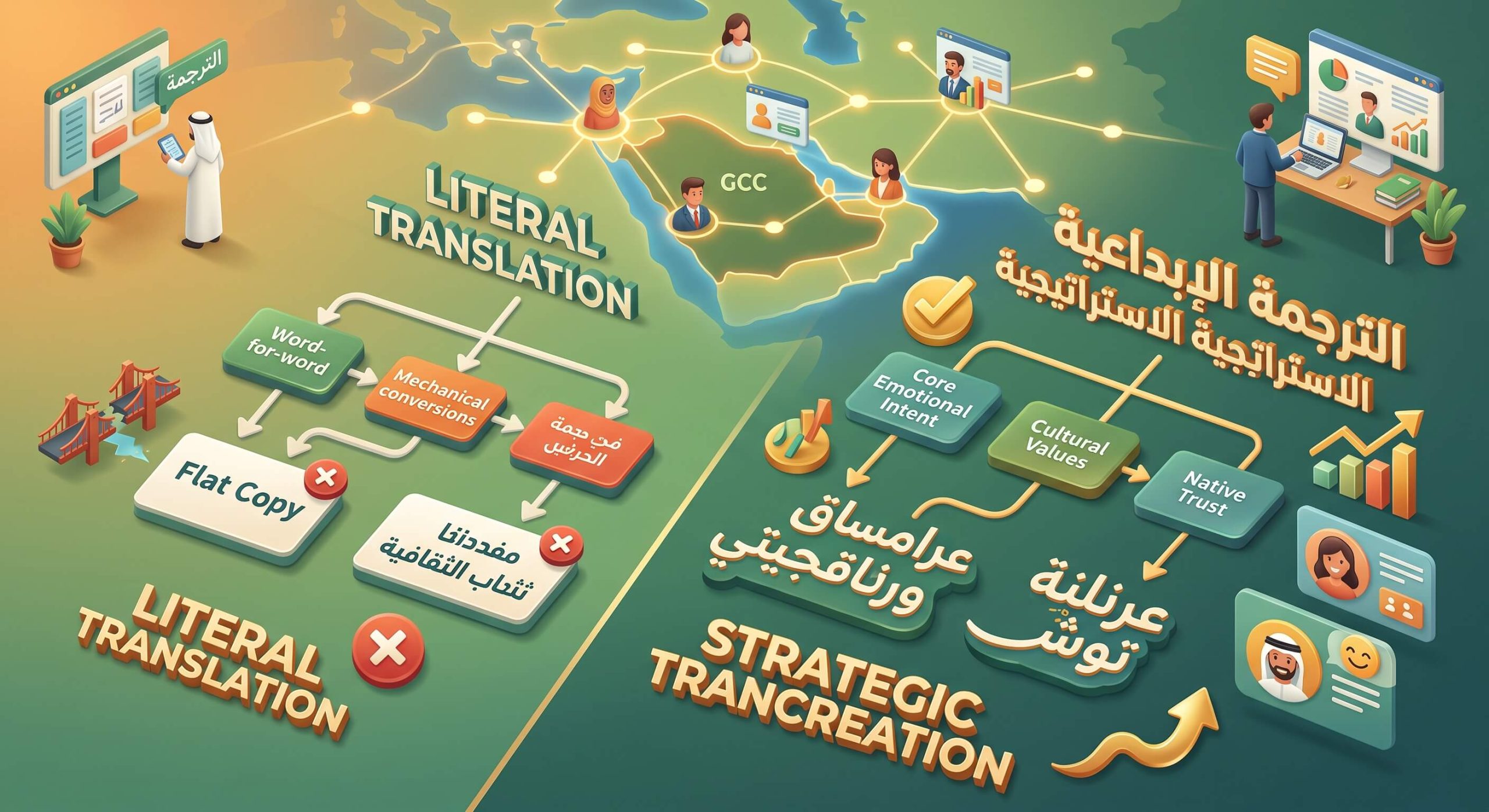
Literature, poetry, and high-end advertising require transcreation, the art of recreating a message in another language while maintaining its intent, style, and emotional impact. AI can’t understand a joke, a double entendre, or the subtle emotional weight of a specific metaphor.
- High-Stakes Diplomacy and Business Negotiations
When you’re in a room (or a Zoom) trying to close a massive deal, tone of voice and body language matter. Professional interpreters do more than translate words; they navigate cultural nuances and ensure that a “yes” actually means “yes” and not just “I hear you.”
- Brand Voice and Identity
Your brand has a personality. Maybe it’s cheeky and bold, or perhaps it’s formal and authoritative. AI tends to default to a “generic” middle ground. To keep your brand voice recognizable from Dubai to Rome, you need a human who understands your “soul.”
The Langpros Approach: Human + AI = The Perfect Match
At Langpros, we don’t believe it’s a battle of “Man vs. Machine.” Instead, we see it as a partnership. We use cutting-edge AI data solutions to drive precision and speed, but we anchor everything in human expertise.
Whether we are supporting a global summit with PTT Microphones and RSI (Remote Simultaneous Interpretation) platforms or localizing a website for the Middle Eastern market, our goal is the same: Natural-sounding translation that feels like it was originally written in the target language.
The Final Verdict
So, is AI translation effective for every project? No.
But is it a game-changer for most modern businesses? Absolutely.
The trick is knowing which tool to use for which job. Don’t use a sledgehammer to hang a picture frame, and don’t use a basic AI bot to translate your company’s legal bylaws.
Not sure which path is right for your next project? We speak your language. Reach out to our team of experts, and let’s find the perfect balance of speed, cost, and soul for your global message.
You May Also Like