
Researched and written by Evan – ~6 min read

Understanding how AI and human interpreting really compare and when each one makes sense.
Artificial intelligence has transformed many parts of how we communicate and interpreting is no exception. More companies, event organizers, and institutions are asking whether AI can replace (or at least assist) human interpreters. But the truth is more nuanced.
AI interpreting is powerful, scalable, and surprisingly convenient, but it’s not perfect. And it’s not always the right choice.
This guide breaks down 20 essential questions everyone should ask before relying on AI interpreting for a meeting, event, or business setting. Whether you’re considering AI for internal calls or evaluating it for large conferences, this article will help you understand how it works, when it works, and when it really doesn’t.
1. What Is AI Interpreting?
AI interpreting converts spoken language into another language in real time using a chain of technologies: speech recognition (ASR), machine translation (MT), and text-to-speech or captions. Instead of a human interpreter listening and speaking back, AI automates the entire process.
2. How Does AI Interpreting Work, Step by Step?
- The speaker’s voice is captured through a microphone.
- AI converts the speech into text (ASR).
- That text is translated into another language (MT).
- Participants receive the output as audio or captions.
This all happens in a few seconds, depending on the quality of equipment and connectivity.
3. What Makes AI Interpreting Appealing?
- Lower cost than hiring multiple interpreters
- Fast availability, no scheduling weeks in advance
- Scalable to many languages
- Easy access for remote or hybrid audiences
- Works anywhere, as long as there’s a device and internet
4. When Is AI Interpreting Actually Useful?
It’s an excellent tool for:
- Hybrid meetings
- Webinars
- Online training
- Large company announcements
- Quick, low-stakes meetings
- Multilingual sessions with many languages but limited budgets
- Secondary languages in big conferences
5. Can AI Interpreting Replace Human Interpreters?
Short answer: No — not yet.
AI struggles with nuance, tone, emotion, humor, and cultural context. For high-stakes scenarios, humans remain essential.
6. What Are the Limitations of AI Interpreting?
- Struggles with accents, dialects, slang
- Can’t fully convey tone or emotion
- Fails with overlapping speakers
- Requires a stable internet connection
- Raises privacy and confidentiality issues
7. How Accurate Is AI Interpreting?
AI can be “good enough” for structured, predictable conversation.
But in complex discussions, human interpreters outperform AI significantly, especially in diplomacy, finance, medicine, or law.
8. How Many Languages Can AI Handle?
This is where AI shines: dozens of languages at once, something nearly impossible with human-only setups.
9. What Equipment Does AI Interpreting Need?
For small meetings, AI interpreting requires almost nothing, that’s part of the appeal.
Often just:
- A laptop or smartphone
- A microphone or built-in device mic
- A stable internet connection
- An AI-capable interpreting platform
For quick discussions, internal meetings, or teams spread across countries, this setup works beautifully. No booths, no receivers, no consoles, just plug in and start.
But for large conferences, high-attendance events, or environments where the AI output must reach hundreds of participants clearly and reliably, it’s a different story.
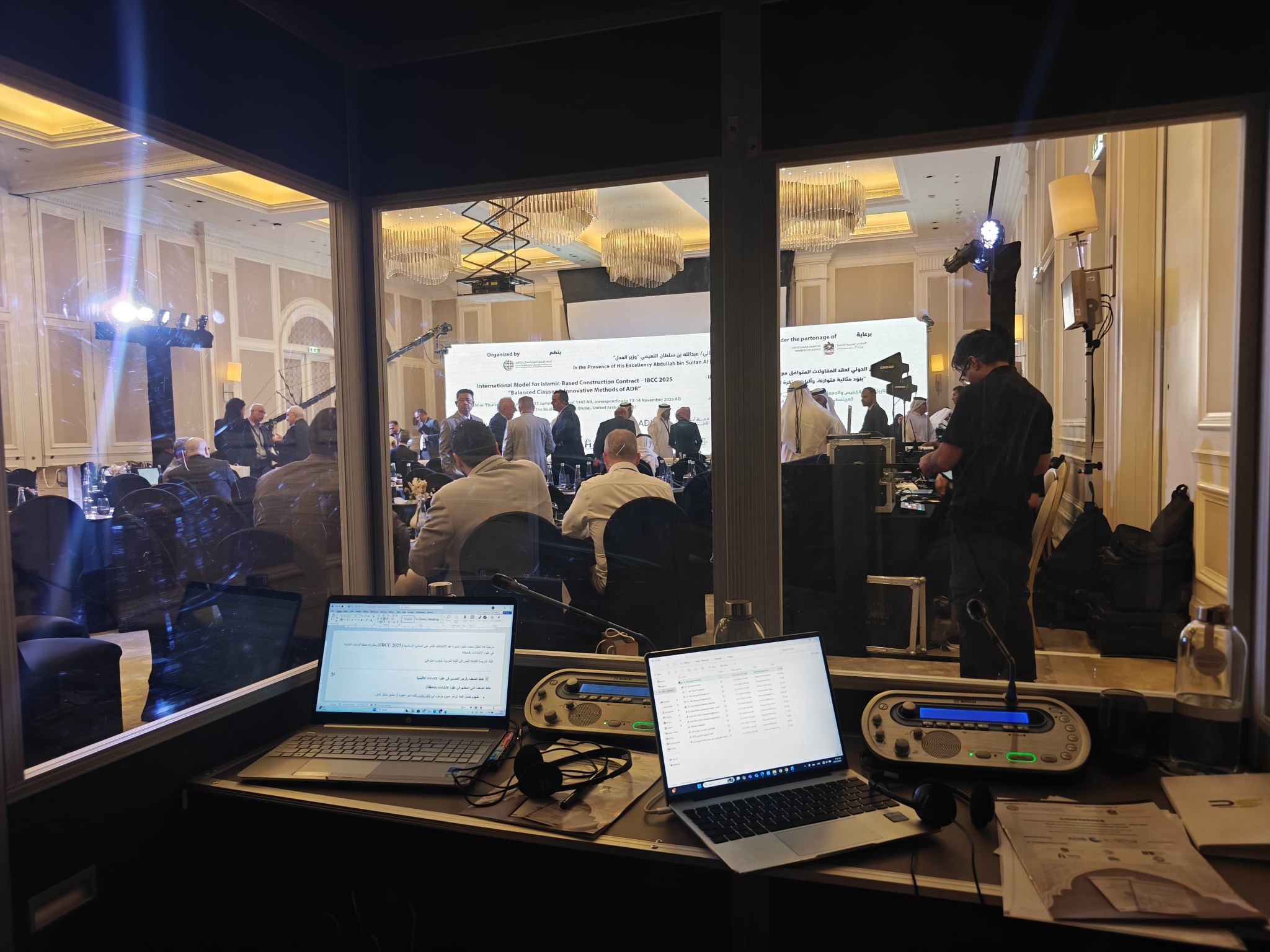
In those cases, AI interpreting performs best when paired with professional conference equipment such as:
- Interpretation headsets & receivers for clean audio distribution
- Interpreting consoles when using hybrid setups (AI + human interpreters)
- PTT microphones to ensure crisp, accurate input
- PTZ cameras for hybrid and livestream events
- Sound systems & mixers to stabilize the audio source
- Presentation monitors & screens for multilingual captions
This combination significantly improves audio quality, reduces errors in speech recognition, and ensures that AI translation remains consistent, even in noisy or complex environments.
In short:
👉 Small meetings = minimal equipment
👉 Large events = best results with professional conference infrastructure
10. How Much Cheaper Is AI Interpreting?
A lot.
That’s why many companies use it for general meetings, training, or internal communication. But low cost comes with tradeoffs.
11. When Should You NOT Use AI Interpreting?
Avoid AI for:
- Medical consultations
- Legal proceedings
- Diplomatic/government meetings
- Financial negotiations
- Emotional or persuasive speeches
- And any big conference with high-stakes communication
12. Does AI Understand Context?
Not well. AI translates words, not intention. It can’t fully interpret sarcasm, cultural references, idioms, or emotional cues.
13. Can AI Handle Technical Vocabulary?
Not reliably.
If your event involves specialized terminology (engineering, medicine, finance), human interpreters are safer.
14. Is AI Good for Very Large Events?
Yes, especially when many languages are needed. AI scales faster and cheaper than human-only setups.
15. Does AI Help With Accessibility?
Absolutely.
Live captions can support people who are:
- Hard of hearing
- Non-native speakers
- Following content in noisy environments
AI interpreting often increases inclusivity.
16. How Fast Can AI Be Set Up?
Within minutes, ideal for last-minute or spontaneous meetings.
17. Can AI and Human Interpreting Be Combined?
Yes and it’s becoming the preferred model.
AI supports scale and speed, while human interpreters cover accuracy and nuance.
18. What AI Interpreting Tools Exist Today?
Many cloud-based platforms provide real-time translation. Some integrate with meeting apps (like Zoom), others run standalone.
19. What Does the Future Look Like?
The future is hybrid:
AI for speed and scale + humans for nuance, safety, and precision.
20. How Should a Company Decide Between AI and Human Interpreting?
Ask:
- What’s the topic?
- How high are the stakes?
- How many languages?
- Is nuance important?
- Is confidentiality required?
Your answers reveal the right approach.
Comparison Table: AI Interpreting vs Human Interpreting
| Feature | AI Interpreting | Human Interpreting |
| Cost | Low | Medium–High |
| Accuracy | Good for simple content | Excellent for all content |
| Tone & Emotion | Weak | Strong |
| Cultural Understanding | Limited | Deep |
| Specialized Vocabulary | Unreliable | Accurate |
| Setup Speed | Instant | Requires scheduling |
| Scalability | Very high | Limited |
| Privacy & Confidentiality | More risky | Safe |
| Best Use Cases | Internal meetings, hybrid events, low-stakes sessions | Diplomacy, government, legal, complex conferences |
Final Thoughts: What Langpros Can Do for You
AI interpreting is not a magic replacement for human expertise, it’s a powerful tool that becomes even more effective when used strategically. And that’s where Langpros comes in.
Whether your event is a small internal meeting or a multilingual international conference, Langpros offers a tailored approach to match your goals, your budget, and the level of accuracy you need.
With Langpros, you get:
- Human interpreters for high-stakes languages and critical sessions
- AI interpreting and live captioning for accessibility or low-priority languages
- Hybrid setups that intelligently combine both
- Full AV infrastructure (booths, headsets, microphones, PTZ cameras, consoles)
- Technical teams on-site to ensure everything runs smoothly
- One partner for every communication need: interpreting, translation, audiovisual, and support
We believe in providing clarity, efficiency, and flexibility under one roof, so your event communication is seamless, accurate, and stress-free.
If you’re considering AI interpreting, hybrid interpreting, or a multilingual setup for your next event, we’re here to help you design the perfect solution. Contact us now!

 Langpros